
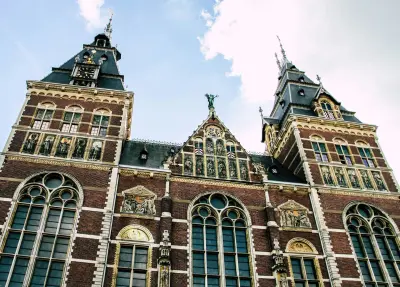
RIJKSMUSEUM HISTORY
Rijksmuseum – home of Dutch masterpieces
The Rijksmuseum has a long and interesting history going back 200 years. Originally named the National Art Gallery and commissioned by the Dutch government, it housed about 200 paintings and historical artifacts. The museum underwent significant renovations, from its original design in 1885 to the latest 10-year renovation that was completed in 2013. Today, it stands as one of the most prominent landmarks in the Netherlands and is among the world’s most famous museums, attracting millions of visitors each year.

The birth of the museum
In 1798, the Dutch government decided to establish a national museum that would present the country’s art and cultural heritage and inspire patriotism. The National Art Gallery opened on May 31, 1800, in Huis Ten Bosch, The Hague. The first collection had around 200 paintings and historical items from private collections and national institutions, including the Dutch East India Company. Its first purchase, The Threatened Swan by Jan Asselijn, cost 100 guilders and remains one of the Rijksmuseum’s top attractions today.

From The Hague to Amsterdam
In 1808, the museum was moved from The Hague to Amsterdam by Napoleon Bonaparte, who ruled the Kingdom of Holland at that time. Amsterdam was established as the capital, and the Royal Museum opened on the upper floor of the Royal Palace on Dam Square, which was originally the town hall. The art collection included important works like Rembrandt’s The Night Watch.

King Willem I and the transformation of the Rijksmuseum
After King Willem I became king in 1813, the museum was named the “Rijksmuseum”, or “National Museum”, and moved to Trippenhuis, a 17th century palace on Kloveniersburgwal. That location was not ideal for the museum’s collection and became too small as the collection expanded. Some collections were relocated, with items from Classical Antiquity going to a new Museum of Antiquities in Leiden. Items from the Applied Arts section went to a Cabinet of Rarities in the Hague. In 1838, a separate museum opened in Haarlem for modern 19th century art. During that period, not many significant art objects were added to the collection.

A new home for Dutch art
By the 19th century, Trippenhuis was no longer suitable for the national museum, and plans were made to design a new building to house Dutch masterpieces. This was a time when museums and grand art galleries were becoming important cultural landmarks in Europe, and the Netherlands wanted its own museum to celebrate its artistic heritage. Designed by Pierre Cuypers in Gothic and Renaissance styles, the construction finally began in 1876 after a lengthy debate about its design. The museum opened in 1885, housing most of Amsterdam’s older paintings, including Rembrandt’s Jewish Bride and works from Haarlem. It also included a dedicated space for the Cabinet of Rarities, a print room, and other prestigious collections.

Renovations and expansions
Over the years, the Rijksmuseum underwent a series of renovations. Between 1904 and 1916, new galleries were added to create the Philips Wing. In the 1950s and ‘60s, the original courtyards were converted into additional gallery space. After 1945, National History and Sculpture & Applied Arts collections were relocated. While plans for a new Dutch history museum did not succeed, a new Asian Art department was established in the 1950s with collections from the Friends of Asian Art.
By the 1970s, the museum was becoming increasingly popular, attracting about 1.5 million visitors each year. However, the building couldn’t meet the needs of a modern museum, leading to discussions about expansion and renovation plans.

Returning to the original design
In 2003, Rijksmuseum began a major renovation that aimed to reorganize the space to improve accessibility for visitors while preserving its historical look according to Cuypers’ original design. The project was led by Spanish architects Cruz y Ortiz, who focused on modernizing the space while keeping the museum’s original architectural features. The museum integrated its painting, applied arts, and history sections to tell a story of Dutch art and history from the Middle Ages to the 20th century. When it reopened in 2013, it attracted over 2 million visitors and remains a popular cultural landmark.
Halls and Galleries
The Rijksmuseum is organized into several halls that present different aspects of Dutch art and history. The Gallery of Honor features famous Dutch masterpieces, leading to The Night Watch Gallery, which is specially dedicated to Rembrandt’s celebrated masterpiece, The Night Watch. The Great Hall provides a stunning setting for displaying Dutch history, with its vaulted ceiling and stained glass windows. Other areas include the Sculpture Gallery and Asian Art Gallery, each displaying various art forms.

Public passage through the museum
As the museum was built on land provided by the city of Amsterdam, the city required a public passage, creating a road underneath that was initially open to all traffic. Since 1931, cars and trucks have been banned from the passage because they could damage the museum, leaving the passage for cyclists and pedestrians. During the renovation from 2003 to 2013, the bike lanes were moved to the center, while the museum entrances were widened.
The largest library in the Netherlands
In addition to its art and historical collections, the Rijksmuseum houses the largest and oldest library in the Netherlands. The elegant Cuypers Library, designed in a beautiful neo-Gothic style, is open to the public and includes both a reading and a study room. Established in 1885, the library reflects Cuypers’s vision of the museum as a space for learning, not just for viewing art. Its impressive collection, which includes around 450,000 items, is continually expanding. In 2004, the library was renovated into a classical reading room, making it even more inviting to visitors and book lovers.

The Rijksmuseum masterpieces
What makes the Rijksmuseum so famous are the masterpieces in its collection. Key works include Dutch masters such as Rembrandt’s The Jewish Bride, his self-portrait, The Night Watch, Vermeer’s The Milkmaid, The Little Street, and Woman Reading a Letter. It also features Van Gogh’s self-portrait, Frans Hals’s The Merry Drinker, and Jan Asselijn’s The Threatened Swan. With over 8,000 objects in 80 galleries, the museum displays a variety of paintings, sculptures, and historical items such as ship models, flags, weapons, and silver and gold objects from the 17th and 18th centuries. The Rijksmuseum also includes a Sculpture and Crafts collection, a national collection of drawings and prints, and an Asian art collection with Indian, Chinese, Indonesian, and Japanese art.
What is so special about The Night Watch?
Rembrandt’s The Night Watch is one of the most famous paintings in the Netherlands and a symbol of Dutch art and culture. Created in 1642, it was moved to the Rijksmuseum in 1808 and has since become one of the museum’s most celebrated works. Its large size and dynamic composition show movement, and Rembrandt’s use of light and shadow highlights important figures. The painting is displayed in a special gallery with carefully designed lighting to emphasize its beauty.
Want to explore the Rijksmuseum & Dutch history and art?

Crowd-free experience
Rijksmuseum Small-Group Tour
Join our guided tour of the Rijksmuseum and explore the rich history of Dutch art and culture. View the masterpieces of the Dutch Golden Age, including Rembrandt's "The Night Watch", Van Gogh's self-portrait, Vermeer's and Jan Steen's paintings, and many more masterpieces from the museum's 8,000 artworks. Your guide will lead you to see the main exhibits and explain the history behind the art.

Rijksmuseum Private Tour
Explore the Rijksmuseum and 17th century Dutch Masters on a personalized tour. Avoid the crowds and enjoy an exclusive experience with a private guide as you view famous paintings by artists like Rembrandt, Van Gogh, and Vermeer. Learn about the techniques and symbolism in their art, and hear stories from their lives. Enjoy tailored attention during your tour, explore at your own pace, and focus on the art pieces that interest you most.